American Saddlebred Performance Division

ESC Rule Book
[ivory-search id=”9853″ title=”Saddlebred Performance”]

CS1.2 PERFORMANCE DIVISION
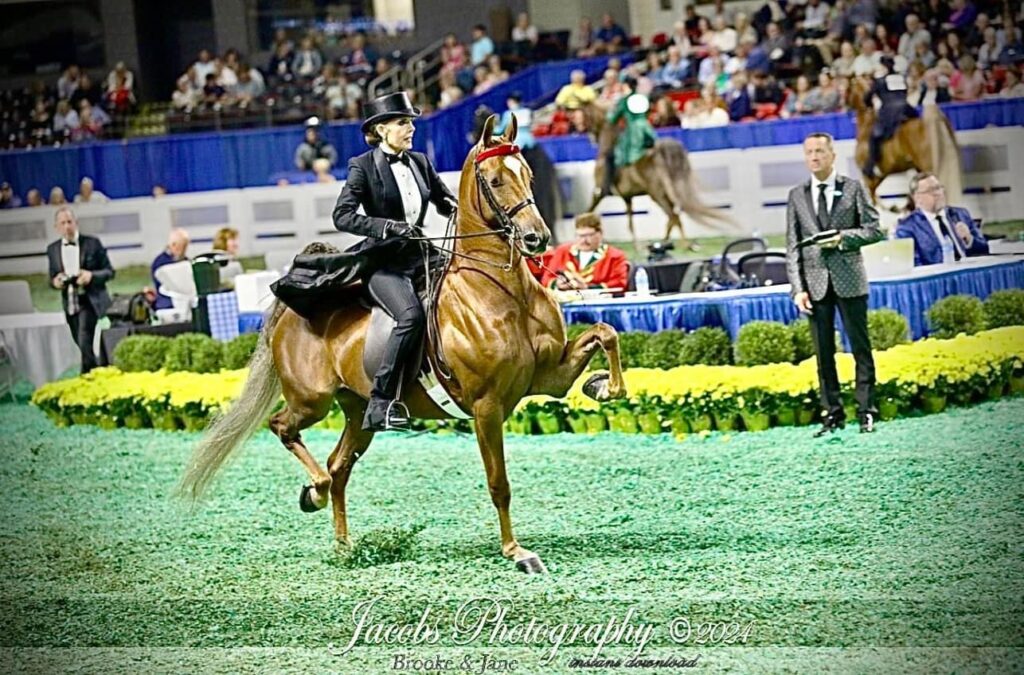
Saddlebred Performance Division
CS1.2a Fine Harness Division
Entries in this division should be elegant, refined and motion should focus on animation over speed. Horses are shown with a full mane and tail.
Tack & Apparel
Presented with a suitable vehicle, ideally a small buggy featuring four wire wheels and lacking a top cover. Light harness equipped with blinkers, a martingale, snaffle bit, and overcheck are mandatory. However, use of an overcheck bit is discretionary .
Gaits
Begin by entering the ring at a park trot. The permitted gaits include an animated walk, park trot, and “show your horse.” However, “show your horse” is exempt from being called in Ladies, Juvenile Exhibitor, Amateur, Masters, Owners, and Amateur Owners classes.
Line Up
Entries are expected to stand calmly in place and are not obligated to back up. They may be unchecked during the lineup. An attendant is allowed to assist the entry by standing it on its feet, but must maintain a distance of at least two paces from the head while the entry is being judged. Only one standard riding crop is permitted for an attendant to carry. Awards will be presented from the lineup.
Ring attendants are permitted to stand quietly inside the gate during Ladies, Amateur, Masters, Owners, Amateur Owners, or Juvenile Exhibitor classes, but they must refrain from taking any action that could influence the performance of any horse.
FINE HARNESS CLASSES OFFERED
Junior Horse, Open, Limit
Horses aged 2 – 4 years old; Maiden or Novice. Exhibited at an animated walk; Park trot (speed to be penalized) and “show your horse”, to stand quietly. Judged on performance, presence, quality, manners and conformation.
Junior Championship
Judged 75% on performance, presence, quality and manners; 25% on total conformation.
Ladies Open or Amateur
Shown at a park trot and an animated walk, stand quietly. Judged on manners, quality, presence, performance and conformation.
Ladies Championship
Judged 75% on manners, quality, presence and performance; 25% on total conformation.
Juvenile, Youth or Amateur
Shown at a park trot and an animated walk, to stand quietly. Judged on manners, performance, presence, quality and conformation.
Juvenile, Youth or Amateur Championships
Judged 75% on manners, performance, presence and quality; 25% on conformation.
For horses to qualify for the Juvenile Exhibitor, Amateur (ladies and/or gentlemen), Masters, Owners, Amateur Owners Championships, and Youth categories, they must be entered and shown by individuals corresponding to their respective categories (Juvenile Exhibitor, Amateur, Masters, Owner, Amateur Owner, and Youth). Additionally, they must participate in at least one other class within this section.
The event management has the discretion to specify in the prize list which classes are eligible for the Championships. For example, Amateur classes may qualify for Amateur Championships, Ladies classes may qualify for Ladies Championship, and so forth.
Grand Championship
Horses are required to be entered, presented, and evaluated in any other class within this section. They should be showcased at an animated walk, park trot, and “show your horse” (with penalties for excessive speed), as well as demonstrate the ability to stand quietly. The judging criteria comprise 75% based on performance, presence, quality, and manners, and 25% on overall conformation.
CS1.2b Five Gaited Division
This division showcases beauty, brilliance, elegance, refinement and speed in an animated form. Entries shall be shown with a full mane and tail.
Tack & Apparel
The preferred bridle is a double bridle, comprising both a snaffle and curb bit, chosen to suit the individual horse. Horses are not allowed to be shown with only a snaffle bit, breastplate, tie-down, or martingale. Exception: 2-Year-Olds may be shown in a snaffle bridle with a running martingale if such is specified in the prize list. The saddle should be an English-type flat saddle with a leather or web girth.
Attire: Exhibitors competing in morning and afternoon classes are expected to wear informal attire. Riders in evening classes should wear a dark-colored habit with appropriate accessories. Loud or flashy colors should be avoided.
Gait Requirements
Flat or animated walk, trot, slow gait, rack and canter.
Class Divisions
Classes may be divided by sex.
PROHIBITED: Stallions in Ladies and Juvenile Exhibitor classes.
FIVE GAITED CLASSES OFFERED
Junior Horse, Open, Limit
Horses between 2yo to 4yo, Maiden or Novice. Judged on performance, presence, quality, manners and conformation.
Junior Championship
Judged 75% on performance, presence, quality and manners; 25% on total conformation.
Ladies Open or Amateur
Judged on manners, quality, presence, performance and conformation.
Ladies Championship Open & Amateur
Judged 75% on manners, quality, presence and performance; 25% on total conformation.
Juvenile Exhibitor, Youth or Amateur
Judged on manners, performance, presence, quality and conformation.
Juvenile Exhibitor, Youth or Amateur Championship
Judging criteria: 75% based on manners, performance, presence, and quality; 25% on overall conformation.
For horses to qualify for the Juvenile Exhibitor, Amateur, Masters, Owners, Amateur Owners, and Youth Championships, they must be entered and shown by individuals corresponding to their respective categories such as Juvenile Exhibitor, Amateur, Masters, Owner, Amateur Owner, and Youth. Additionally, they must participate in at least one other class within this section.
Event management reserves the right to specify in the prize list which classes are eligible for the Championships. For example, Amateur Classes may qualify for Amateur Championships, Ladies Classes may qualify for Ladies Championship, and so forth.
Juvenile Exhibitor, Youth or Amateur Grand Championship
To qualify, horses must be entered, shown, and judged in at least one other class within this section. Judging will be based on 75% performance, presence, quality, and manners, and 25% on overall conformation.
Combination Harness & Saddle
The class begins with horses being shown to a suitable four-wheeled vehicle at an animated walk and trot. Following this, they are presented under saddle, where they perform at an animated walk, trot, slow gait, rack, and canter.
Judging criteria are divided equally: 50% based on suitability for harness and 50% on saddle work, with a particular emphasis on the trot. Light harness with blinkers, a martingale, snaffle bit, and overcheck are mandatory, although the overcheck bit is optional. The prize list should specify whether the driver/rider must be the same individual for both phases of the class.
CS1.2c Three Gaited Division
The ideal horse is characterized by beauty, elegance, brilliance, refinement, and expressive qualities. Collection in stride, with energy focused on precise animation. The horse is presented with a roached mane, although Two-Year-Olds have the option of showing with a full mane. Both roached and full tails are permitted.
Stallions are prohibited from participating in Ladies and Juvenile Exhibitor classes. Classes may be further divided based on sex (Mares, Stallions/Geldings) and height categories, such as 15.2 hands and under, and Over 15.2 hands.
Tack & Apparel
The preferred bridle is a double bridle consisting of both a snaffle and curb bit, chosen to suit the individual horse. Horses are not permitted to be shown with only a snaffle bit, breastplate, tie-down, or martingale. Exception: 2-Year-Olds may be shown in a snaffle bridle with a running martingale if such is specified in the prize list.
An English-type flat saddle should be used, with either a leather or web girth.
Attire: Riders are required to wear informal dress for morning and afternoon classes. For evening classes, formal attire or a dark-colored habit (with collars and lapels of the same color) and appropriate accessories are recommended. Loud or flashy colors should be avoided.
Gait Requirements
Horses are to be presented at either a flat walk or animated walk, followed by a park trot and canter.
Class Divisions
Classes may be divided by sex.
PROHIBITED: Stallions in Ladies and Juvenile Exhibitor classes.
THREE GAITED CLASSES OFFERED
Junior Horse Open, Maiden, Novice
For horses aged 2yo – 4yo or with Maiden, Novice status. Judged on performance, presence, quality, manners and conformation.
Junior Horse Championship
For horses aged 2yo – 4yo or with Maiden, Novice status having shown in the qualifier. Judged 75% on performance, presence, quality and manners; 25% on total conformation.
Ladies Open or Amateur
Judged on manners, quality, presence, performance and conformation.
Ladies Open or Amateur Championship
Ladies only Open or Amateur Championship. Judged 75% on manners, quality, presence and performance; 25% on total conformation.
Juvenile Exhibitor, Youth or Amateur
Judged on manners, performance, presence, quality and conformation.
Juvenile Exhibitor, Youth or Amateur Championship
Judging for this competition is based on the following criteria: 75% on manners, performance, presence, and quality, and 25% on total conformation.
In order for horses to be eligible for the Juvenile Exhibitor, Amateur (ladies and/or gentlemen), Masters, Owners, Amateur Owners, and Youth Championships, they must be entered and shown by individuals corresponding to their respective categories; Juvenile Exhibitor, Amateur, Masters, Owner, Amateur Owner, and Youth). Additionally, they must participate in at least one other class within this section.
Event management has the authority to specify in the prize list which classes qualify for the Championships. For instance, Amateur Classes may qualify for Amateur Championships, Ladies Classes may qualify for Ladies Championship, and so forth. For stripping Championships, please refer to the Stripping Rule stated elsewhere.
Juvenile Exhibitor, Youth or Amateur Grand Championship
In order to be eligible, horses must be entered, shown, and judged in at least one other class within this section. Judging will be based on 75% performance, presence, quality, and manners, with 25% of the score attributed to total conformation.
Combination Harness & Saddle
The class begins with horses being presented to a suitable four-wheeled vehicle at an animated walk and park trot. Following this, they are shown under saddle, performing at a walk, park trot, and canter. The prize list must specify whether the driver/rider must be the same individual for both phases of the class. Entries are to be driven with a liverpool bit with side check. Judging criteria are divided equally: 50% based on suitability for harness, and 50% on saddle work, with a particular emphasis on the trot.
CS1.2d Park Division
The American Saddlebred and Half American Saddlebred Park Horse are expected to exhibit style, refinement, and good manners. Their performance should be characterized by animation and grace in all gaits. Horses competing in any class within this section are not eligible to compete in the American Saddlebred/Half American Saddlebred Pleasure Division, including Park Pleasure, at the same event.
However, they may compete in Performance sections (such as Three-gaited, Five-gaited, Fine Harness), as well as In-Hand, Parade, or Model classes. Horses may have either a roached or full tail, which is either set or natural.
Tack & Apparel
Under Saddle:
- Bridle: A double bridle with both a snaffle and curb bit is preferred, selected to suit the individual horse. Exception: 2-Year-Olds may be shown in a snaffle bridle with a running martingale if such is specified in the prize list.
- Saddle: The saddle should be an English-type flat saddle with a leather or web girth.
- Attire: Riders are required to wear informal dress for morning and afternoon classes. For evening classes, a dark-colored habit (with collars and lapels of the same color) and appropriate accessories are recommended. Loud or flashy colors should be avoided.
Driving:
- Horses are to be presented to a suitable vehicle, preferably a small buggy with four wire wheels and no top.
- Light harness with a snaffle bit, blinkers and running martingale and overcheck are mandatory. The use of an overcheck bit is optional.
Gait Requirements
Horses are to be presented at an animated walk or flat walk, park trot, and canter, with the addition of slow gait and rack in Five-Gaited classes. The gaits will be park trot and animated walk in Fine Harness classes. Horses are expected to stand quietly.
Class Divisions
Stallions are not permitted to compete in Ladies and Juvenile classes.
Classes may be divided based on the size of the horse (15.2 hands and under, Over 15.2 hands), the age or sex of the rider, and the sex of the horse (Stallion, Gelding, and Mare classes).
PARK CLASSES OFFERED
Open
Horses participating in the Open, Junior, Maiden, Novice, Limit, and respective Championships classes are required to be shown at a walk, trot, and canter. They will be judged on performance, manners, presence, quality, and conformation.
Juvenile, Youth, Ladies or Amateurs
In the Owners, Amateur Owners, Masters, Juvenile Exhibitors, Youth, and Championship classes, horses are to be shown at a walk, trot, and canter. During the lineup, horses are expected to stand quietly. Judging will be based on manners, performance, presence, quality, and conformation.
Five Gaited Park
Shown at a walk, trot, canter, slow gait and rack. To be judged on performance, manners, presence, quality and conformation.
Fine Harness Park
Horses are to be presented at an animated park trot, with penalties for excessive speed, as well as at an animated walk. They should stand quietly during evaluation. Judging will be based on performance, manners, presence, quality, and conformation.
CS1.3 Saddlebred-Type Pony
The ponies in this division should closely resemble the American Saddlebred breed and possess the graceful trot and easy canter typical of the breed, regardless of whether they are registered with a breed organization.
Classes in this category will adhere to the standards and specifications set forth in comparable American Saddlebred classes.
Ponies must be ridden by Juvenile Exhibitors, emphasizing manners and agreeable attitudes.
These classes are restricted to mares and geldings measuring 14.3 hands and under. Owners must provide proof of height. Official Measurements from other governing organizations will be accepted. Ponies must be measured according to the following rules:
- Ponies aged 5 years and under must be measured annually to participate in classes restricted to American Saddlebred-type ponies.
- A pony’s height is considered permanent at 6 years of age.
- Ponies must be unshod when officially measured but may have a ¼” pad or plate (to be subtracted from measurement) left on the foot for protection.
- Registered American Saddlebred ponies may be shown in the American Saddlebred horse division only if there are no pony classes offered at that particular show.. This does not affect the pony’s status for the remainder of the competition year. If ownership is transferred during the competition year, the horse/pony may be shown in either division according to the above rules.
Classes may be further divided by the age of the rider or the size of the pony, with categories for those 12.2 hands and under, and those over 12.2 hands but not exceeding 14.3 hands.
SADDLEBRED-TYPE PONY CLASSES OFFERED
Three Gaited Saddlebred-Type Pony
Shown at a walk, trot and canter. Judged on manners, performance, presence, quality and conformation.
Five Gaited Saddlebred-Type Pony
Shown at a walk, trot, slow gait, rack and canter. Judged on manners, performance, presence, quality and conformation.
Fine Harness Saddlebred-Type Pony
Shown at a Park Trot with penalties for excessive speed, and an animated walk, displaying the ability to stand calmly. Evaluation is based on manners, performance, presentation, demeanor, and conformation. Entry to pull a four-wheeled carriage equipped with proper light harness, including a martingale, a bridle with square blinkers, and a snaffle bit. The use of an overcheck bit is discretionary.
Three Gaited – Country Pleasure Saddlebred-Type Pony
Participants have the option to exhibit with either English or Western gear. The trot or jog should match the type of equipment chosen. Competitors are required to showcase at a walk, trot or jog-trot, extended trot, and canter or lope. Additionally, they must stand calmly along the rail and while lined up, and readily back up when requested. Evaluation criteria consist of 75% based on manners, performance, presence, and quality, with the remaining 25% focused on conformation and the tidiness of attire.
Country Pleasure Saddlebred-Type Driving Pony
Participants are to be presented alongside a suitable two-wheeled vehicle equipped with proper harnessing, including a martingale and blinkers. Drivers who are under 14 years of age may be accompanied by an adult. Exhibits are required to perform a flat walk, trot, and extended trot, with penalties for excessive speed. They must also demonstrate the ability to stand quietly along the rail and while lined up, and to back up readily. The use of quarter boots is not permitted. Evaluation is based on manners, performance, presence, quality, and conformation.
Three Gaited Saddlebred-Type Show Pleasure Pony
Participants are to be displayed performing a flat walk, trot, and canter. They must also exhibit the ability to stand quietly and back readily while in the line-up. Evaluation criteria include manners, performance, presence, quality, and conformation.
CS1.4 In Hand and Model Division
In-Hand classes, including open and futurity categories, are governed by specific regulations. Additional guidelines apply for Pleasure In-Hand and Youth Showmanship classes. Only two individuals per animal are allowed in the ring. Handlers and attendants must be neatly attired in clean, well-fitted clothing. Each may carry or use a whip not exceeding 6 feet, including the lash, which should remain unaltered except for the attachment of no more than two ribbon streamers, each eight inches or less in length. The whip must adhere to standard specifications.
Tack & Apparel
Entries are required to be led into the ring and presented either in bridle or halter, without the use of quarter boots, blinkers, blindfolds, or any other appliances. Specifically prohibited for weanlings and yearlings are curb bits and tail sets.
The use of artificial appliances or devices such as chains, shackles, rubber bands, or blindfolds on weanlings and yearlings is strictly forbidden both before and during competition. Smooth, round leather straps are permissible prior to entering the competition ring.
Blinker hoods with half cups mounted in a vertical position, allowing forward vision, are permitted on weanlings and yearlings before entering the competition ring.
Weanlings and yearlings must exhibit with unset tails; the use of tail sets and bustles on the competition grounds, in preparation for the event, is explicitly prohibited for weanlings. However, bustles are permitted on yearlings.
Any entry found with prohibited equipment will be disqualified, resulting in the forfeiture of all entry fees and winnings for that competition.
Gaits
Entries are evaluated based on the standards for the walk and trot. Each entry enters the ring individually, trotting upon entry. They are judged individually while standing, walking, and trotting on the lead. Horses should stand squarely on all four feet, with the front legs perpendicular to the ground. While the rear legs may be slightly positioned backward, handlers may be requested to adjust the hind legs for inspection if necessary.
Standards of Judging
Conformation and finish contribute 50% of the total score. All entries are assessed based on the standards for the ideal American Saddlebred/Half American Saddlebred type and conformation. Defects and undesirable traits are to be penalized accordingly. The way of going and natural action also account for 50% of the total score, with severe penalties for any signs of labor.
If a judge decides to conduct a second workout, selected horses must perform a walk and trot on the lead.
IN HAND CLASSES OFFERED
Open and Amateur
For horses that are weanlings, colts and/or fillies.
Yearlings
For horses that are colts, geldings and/or fillies.
Two-Year-Olds
For horses that are colts, geldings and/or fillies.
Three-Year-Olds
For horses that are; Three-Gaited, Five-Gaited/Fine Harness, Stallions & Geldings and/or
Mares.
Four-Year-Olds and Over
For horses that are; Three-Gaited, Five-Gaited/Fine Harness, Stallions & Geldings and/or
Mares.
Stallions Suitable to Get
For Three-Year-Olds and over
Sire & Get
Stallion to be shown with two or more of Get
Get of Sire
Two or more of Get to be shown without Sire
Broodmares
May be divided into mares that have produced foals and mares that have been bred but have not produced
Dam and Produce
Mare to be shown with two or more of produce.
Produce of Dam
Two or more of produce to be shown without Dam.
Model
In Model classes, entries are exclusively evaluated based on conformation and finish, with no assessment of movement while on the line. The way of going is not taken into consideration.
For Three-Gaited classes, entries are to have a roached mane and are led into the ring wearing either a bridle or halter, without the use of quarter boots.
In Fine Harness and Five-Gaited classes, entries are required to have a full mane and tail and are led into the ring wearing either a bridle or halter, without the use of quarter boots.
CS1.5 Youth Showmanship Division
The exhibitor’s performance is evaluated based on their skill in showcasing the horse in the ring to its best advantage, effectively minimizing any conformation faults. The judging criteria consist of: 50% for presentation and showmanship skills, 40% for the horse’s condition, grooming, and fitting, and 10% for the exhibitor’s appearance.
Tack & Apparel
Weanlings should be presented in a leather show halter with matching lead.
Yearlings may be presented in same as above, or a snaffle bridle. No curb bits permitted.
Two-Year-Olds and older may be shown in a double bridle or single curb bit.
A riding whip with no attachment, such as a bag or ribbon, is allowed.
Exhibitor’s attire should be jodhpurs or dark pants, a long-sleeved shirt and tie, vests or western/hunter attire, and appropriate boots. Coats are not allowed, and hats and gloves are optional.
Gaits
Participants are required to enter the competition ring at the designated gait and follow the direction indicated by the ringmaster until instructed to line up the horse for inspection.
Standards of Judging
Maintaining a distance of at least ten feet between entries is advised both when circling the ring and during the line-up. The horse should stand squarely with its weight evenly distributed on all four feet, hooves facing forward, and front legs perpendicular to the ground.
Handlers may adjust the horse’s position by using the lead rein and applying pressure to the shoulder if necessary. However, using a foot or whip to move the horse’s feet will result in penalties. Handlers must position themselves in front of the horse to ensure the judge has a clear view, avoiding obstruction.
Handlers should remain attentive to both the horse and the judge, disregarding distractions outside the ring. The lead rein should be held in the right hand, approximately 12 to 24 inches from the halter or bit, with the other end held neatly in the left hand. Changing hands is permissible for convenience during positioning or presentation.
Handlers should maintain a well-balanced body posture to allow for fluid movement and proper presentation of the horse. When the judge is examining other entries, handlers should position themselves at the horse’s head on the opposite side of the judge whenever possible. Promptly following instructions and making mild adjustments to the horse are allowed.
In-Hand Youth Showmanship Workouts
A suitable standard routine for the required individual workout:
The handler should position themselves to the left of the horse and begin leading with a loose rein if feasible, guiding from the left side. In cases where needed, a gentle touch of the whip is permitted.
The horse should move forward briskly and in a straight line. When moving away from the judge, the horse should maintain alignment with the judge for proper observation of its movement.
At each end of the line, the horse should come to a complete stop before turning. Turning should be executed to the right, away from the handler, at the end of the line.
During periods when the judge is assessing other horses, the horse should stand reasonably well-presented. The handler should remain attentive and poised until the entire class has been evaluated and the judge has completed their assessment.
Handlers should adopt a natural approach and refrain from excessive handling, unnecessary fussing, or over maneuvering. They should promptly respond to requests from the judge or other officials, maintaining courtesy and good sportsmanship throughout.
Penalties will be applied for incorrect or unkempt attire, inadequately groomed or trimmed horses, improper or dirty equipment (such as keepers out or twisted cheek pieces), excessive use of whips or reins, interference with other exhibitors, receiving coaching from outside the ring, adopting exaggerated, stiff, or rigid positions, and failing to follow instructions.
CS1.6 Parade
The Parade horse should embody the desirable conformation traits of American Saddlebred or Half American Saddlebred breeds and possess adequate size and substance to comfortably support the rider’s weight and Parade equipment.
Variations in color are acceptable, and the horse should showcase a full mane and tail, which may be set. Desirable attributes include action, collection, and brilliance, with conformation being a crucial consideration in Championship Classes.
Stallions are not permitted in Ladies and Juvenile Exhibitor classes.
Tack & Apparel
Rider and equipment must be comparable to the size of the horse. Stock saddle with silver, Mexican or other appropriate equipment. Riders to wear colorful and typical of the Old West, and/or American, Mexican or Spanish origin attire to include fancy cowboy suit, hat and boots. Spurs, guns, serapes, etc., are optional.
Gaits
Horses in this class should be presented at an animated walk and a parade gait, with a maximum speed limit set at 5 MPH. It’s important to demonstrate a noticeable distinction between these two gaits. Horses may be asked to halt on the rail during the performance to exhibit their willingness to stand quietly.
Standards of Judging
Undesirable traits include exhibiting excessive speed, poor manners, a bad mouth, failure to stand quietly, and irregular gaits. The judging criteria for this class emphasize 75% for performance, manners, quality, and conformation, with the remaining 25% dedicated to evaluating the Tack & Apparel of both horse and rider.
PARADE CLASSES OFFERED
Parade Open
This class division is open to various categories including Ladies, Juvenile Exhibitor, Amateur (Ladies and/or Gentlemen), Youth, Owners, Amateur Owners, Pinto, Palomino/Golden, and Solid Color other than Palomino/Golden.
CS1.7 Roadster
The Roadster class requires horses to possess good Purebred Saddlebred or Half Saddlebred conformation and to be presented with a full mane and tail. It’s crucial to note that tails must not be put in a tail brace or any other device. Wagon Roadsters are expected to have more substance and height compared to Bike Roadsters.
Tack & Apparel
Entries should be hitched to a bike or wagon that displays good appearance and stability. The harness, which includes a martingale, should consist of bridles with square blinkers, a snaffle bit and overcheck, a breast collar with straight flaps, and traces made round with flat ends. Reins should be made of tan leather and rounded up to the handpieces. Quarter boots are optional.
Gaits
During the performance, Roadsters must enter the ring clockwise at a jog-trot, then transition to the road gait. On the reverse, they should be shown at the jog-trot, road gait, and then at speed. All three gaits must be demonstrated.
Horses should remain on the rail at all times except when passing and should go to the far end on every corner without side-reining. They should exhibit light mouthedness, be capable of being collected at any time, and be willing to walk and stand quietly when being judged in the center of the ring.
Standards of Judging
Judging criteria shall focus on performance, speed, quality, and manners, with an emphasis on manners in Amateur and Juvenile Exhibitor classes.
At all speeds, Roadsters should maintain proper form, with chins set and legs working beneath them, moving collectedly. They should exhibit animation, brilliance, and competition ring presence while working at the jog-trot and road gait. Undesirable traits include long, sprawling front action, dragging or trailing hind legs, and straddle-gaited action behind, all of which indicate imbalance. Pacey or mixed gait, pacing and racking on turns, or breaking and running on turns will be penalized.
ROADSTER CLASSES OFFERED
The classes available include Amateurs, Juvenile Exhibitors, Youth, Open, Under Saddle, and Championships. It’s important to note that Under Saddle classes are not eligible for Bike/Wagon Championships. However, classes may be offered for horses shown to a wagon.
CS1.8 Ladies Side Saddle
The American Saddlebred Ladies Side Saddle horse should exemplify the typical characteristics of the American Saddlebred breed.
Tack & Apparel
Appropriate bridles should mimic requirements in the same division (Saddle Seat, Hunter Country Pleasure or Western Country Pleasure) as the Side Saddle entry is being presented. Bridles that depict a Period Costume are allowed, but martingales and tie downs are not permitted.. Side Saddle Attire consists of a skirt, split skirt or apron, hat, and appropriate boots. Protective headgear is permitted. In Saddle Seat daytime classes, informal Saddle Seat attire is allowed, while more formal attire may be worn in the evenings. Hunter and Western attire should be the same as Hunter Country Pleasure and Western Country Pleasure attire. Period attire is also acceptable. Exhibitors may use spurs, a whip or crop. Entries are not not disqualified for insufficient Tack & Apparel, but must be penalized.
Gaits
Competitors are required to enter the ring in a counterclockwise direction at the trot or jog-trot, with all gaits to be considered equally. Classes may be divided into English or Western if there are sufficient entries.
Standards of Judging
Emphasizing safety, both in Tack & Apparel and attire, is paramount. Judges are instructed to penalize exhibitors who do not adhere to good safety practices.
Horses participating in the Ladies Side Saddle section may also compete in the American Saddlebred Pleasure sections or the Half American Saddlebred Pleasure section, provided they meet the requirements of their respective sections, including considerations such as the use of artificial appliances, shoeing, tail sets, Tack & Apparel, and attire.
The side saddle horse should convey the impression of being a comfortable mount to ride. A ground-covering walk, a comfortable trot or jog-trot, and an easy, flowing canter or lope are desirable. Transitions between gaits should be smooth and effortless, and riders may choose to either sit or post to the trot.
LADIES SIDE SADDLE CLASSES OFFERED
Ladies English Side Saddle
Ladies Hunt Side Saddle
Ladies Western Side Saddle
Horses in this class are required to be shown at a walk, trot or jog-trot, and canter or lope in both directions of the ring. They should readily back up if requested by the judge and stand quietly throughout the performance. The judging criteria allocate 85% of the score to manners, performance, suitability, quality, and conformation, with the remaining 15% dedicated to evaluating appropriate side saddle attire. Emphasis is placed on manners and suitability of purpose, with suitability referring to the horse’s suitability as a side saddle mount.
Ladies Side Saddle Championships
For eligibility, a horse must have been entered, shown, and judged in a designated qualifying class within the Ladies Side Saddle section. During the competition, horses are expected to perform at a walk, trot or jog-trot, and canter or lope in both directions of the ring. They should readily back up if requested by the judge and maintain quiet standing. The judging criteria allocate 85% of the score to manners, performance, suitability, quality, and conformation, with the remaining 15% dedicated to evaluating appropriate side saddle attire. Emphasis is placed on manners and suitability of purpose, with suitability referring to the horse’s compatibility as a side saddle mount.
CS1.9 Dressage Prospect Division
For the Dressage Prospects division, horses should exhibit the potential to excel as dressage mounts. Horses that have competed at First level Dressage or above are ineligible for this class. Emphasis is placed on form to function.
American Saddlebreds/Half American Saddlebreds suitable for Dressage typically have a higher set-on neck than Hunter types, with adequate length and flexibility of the poll. Movement should be free, elastic, active, and regular, with a good push from behind without tension, and a tendency toward an uphill balance.
The objective is to confirm that the horse’s muscles are supple and loose, and that it moves freely forward in a clear, steady rhythm, while accepting contact with the bit. The horse should exhibit lightness of the forehand and engagement of the hindquarters.
Penalties will be applied for resistance and tension in the horse. The horse’s potential as a Dressage mount is paramount. Entries must have full mane and tail, with tails not being altered by any devices on the show grounds. Artificial manes are prohibited, but manes and tails may be braided or secured with thread, yarn, or bands. Decorations such as ribbons are not allowed, though inconspicuously applied hair in the tail is permitted.
Professionals may compete in Open classes, and the class is open to stallions, mares, and geldings. However, Juvenile Exhibitors may not show stallions.
Tack & Apparel
Bridles may be either a Dressage or Hunter-type snaffle bridle with a smooth snaffle bit. The noseband options include a regular cavesson, a drop noseband, a flash noseband, or a figure-eight noseband. Not permitted in competition: martingales of any type, draw reins, mouth controls, artificial appliances, boots, and bandages.
Saddles must be either an English Dressage or all-purpose English type saddle. Saddle pads of the Dressage-type are required and should be white or of a conservative color.
Riders are required to wear a traditional short riding coat in a conservative color, with either a tie, choker, or stock tie, or an integrated stand-up collar. Breeches should be white or light-colored, or hunter jodhpurs, along with boots or jodhpur boots. Protective headgear is mandatory. A cutaway coat (modified tailcoat) with short tails is permitted. Gloves in a conservative color are recommended. Half chaps, gaiters, and/or leggings are not permitted.
Spurs must be made of metal and only English-style spurs are allowed. The shank can be either curved or straight, pointing directly back from the center of the spur on the rider’s boot. If the shank is curved, it must be worn with the shank directed downwards, although swan-necked spurs are allowed with the curved shank directed upwards. The inside arm of the spur must be smooth, and one or both arms may have rubber covers. If rowels are used, they must be blunt/smooth and free to rotate. Metal spurs with round hard plastic knobs on the shank are allowed (known as “Impuls” spurs). “Dummy” spurs with no shank are also permitted. The maximum length for spurs is 5.08 inches (2 inches), including rowels. This restriction applies to warm-up and training areas, as well as during competition.
Riders may carry one whip no longer than 47.2 inches (120cm), including the lash, in all classes. An adjustable-length whip is not permitted for mounted riders.
Gaits and Standards of Judging
The walk should have a regular, free, and unconstrained rhythm. The trot should be free, active, and regular, with balanced and elastic steps demonstrating a supple back, suspension, and well-engaged hindquarters. The canter should be light, cadenced, and regular.
Trot work should be ridden rising. Horses are placed based on their innate quality of movement, with all gaits being pure in rhythm, without tension or resistance. Transitions should be balanced and without hesitation.
During the rein-back, the horse should remain calm and obedient, lifting and setting down its feet without shuffling. When lengthening the stride at the walk, trot, or canter, the horse should maintain rhythm, regularity, and balance while reaching with its frame and stride, with the rider maintaining contact with the bit and allowing the lengthening. The strides should cover more ground, while the horse remains calm and supple.
DRESSAGE CLASSES OFFERED
Dressage Suitability
This class is open to horses qualified to compete in various class types, including Open, Amateur, Juvenile Exhibitor, Youth, Junior Horse, Stallions, Geldings, and Mares. Horses are required to perform at the walk, trot, and canter in both directions of the ring. They may be asked to lengthen stride at any gait, with transitions into and out of the canter called for through the trot. Horses will also be asked to reverse direction at the trot. Additionally, a free walk on a long rein with the horse stretching forward and down should be performed in at least one direction. During the lineup, horses should stand quietly and may be asked to back at the judge’s discretion.
Judging is based on 70% for the performance of gaits and transitions, with attention to impulsion and submission, using the specified objectives as reference points. The remaining 30% is allocated to the rider’s position, seat, and effective use of aids.