Dutch Harness – Show & Class Concepts

ESC Rule Book
[ivory-search id=”9831″ title=”Rule Book Search Dutch Harness”]

SC4.0 American Dutch Harness – Show Concepts
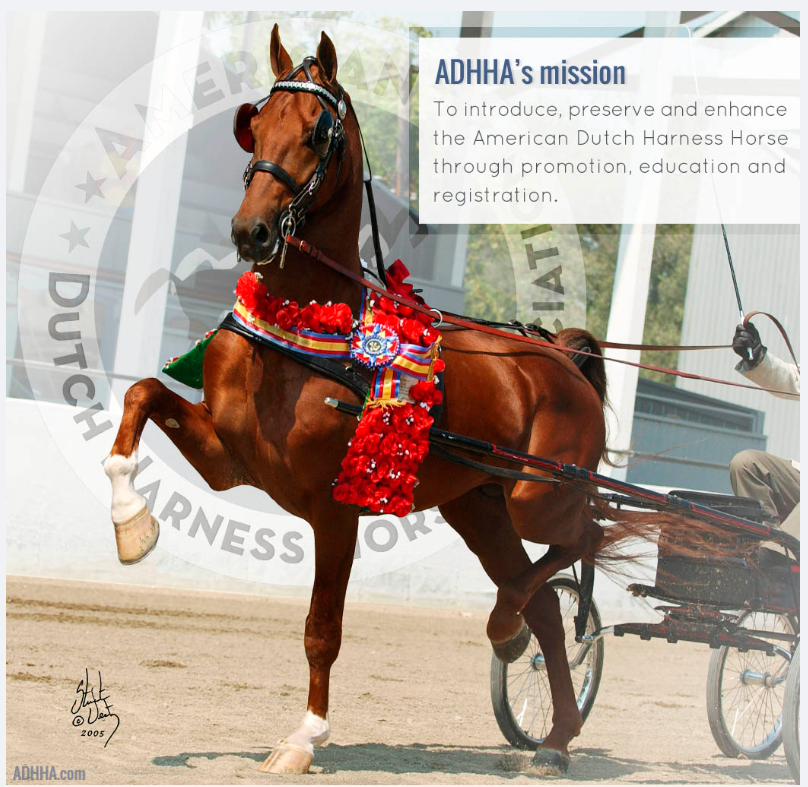
- SC4.0 American Dutch Harness – Show Concepts
- American Dutch Harness Horse
- SC4.0 Sports Concepts – American Dutch Harness Horse
- SC4.3 Competitions
- SC4.4 Type and Conformation
- SC4.5 American Dutch Harness Horse – General Show Ring Protocol
- CS4.0 Class Specifications – American Dutch Harness Horse
- CS4.1 American Fine Harness Class
- CS4.2 American Dutch Harness – Park Saddle Class
- CS4.3 American Dutch Harness Horse – In-Hand Class
- CS4.4 American Dutch Harness – English Pleasure Saddle
- CS4.5 American Dutch Harness – Pleasure Driving
- CS4.6 American Dutch Harness – Roadster to Bike, Wagon and Under Saddle
SC4.0 Sports Concepts – American Dutch Harness Horse
SC4.1 Breed History
The American Dutch Harness Horse is known throughout the show horse industry for its natural trotting ability, high-stepping motion, and powerful cadence. A warm-blood breed founded in the Netherlands, with the first stud book documented in 1879, the Dutch Harness Horses were known as “Sunday Driving Horses” and were often referred to as the “Tuigpaard” or “carriage horse” across much of Europe. Dutch Harness Horses were introduced to the United States during World War II as fine driving horses. American show horse breeders further refined the Dutch Harness Horses for show ring competition, primarily focusing on bloodlines that consistently delivered high-stepping action.
SC4.2 Breed Registry
The American Dutch Harness Horse Association (ADHHA.org) is a not for profit organization based in Shipshewana, Indiana and serves as the official breed registry in the United States. Their mission is “To Introduce, Preserve and Enhance the American Dutch Harness Horse through Promotion, Education and Registration.”
American Dutch Harness Horse Association – Registered vs Recorded Horses
Horses with 50% or more Dutch Harness Horse bloodlines, as determined by pedigree and DNA, qualify for American Dutch Harness Horse Association (ADHHA) Registration. Offspring from ADHHA-Registered sires and dams are also eligible for Registration. The ADHHA offers Futurity and competition programs that promote the breed.
Any mare, stallion, or gelding of any pedigree or stud book may be Recorded with the ADHHA. Any ADHHA-Recorded horse that goes through the Keurig Exhibition and is selected by the ADHHA is then eligible for Registration. To compete in ADHHA classes, horses must have a Breed Registration Number. Horses from other pedigrees that are only Recorded (not Registered) are not qualified to compete in ADHHA classes.
American Dutch Harness Horse Association – Keuring Exhibition & Approved Breeding Stallions
The ADHHA produces an approved stallion list for its membership and horse registry. All American Dutch Harness Horse stallions must go through a Keuring (Dutch word meaning “excellence”) exhibition, where the results determine which stallions are approved by the ADHHA for breeding purposes. Stallions are evaluated by breed experts on conformation, correctness and quality of motion and cadence, as observed between the front and back legs while the horses are shown in-hand. For Keuring Exhibition rules and the list of approved American Dutch Harness stallions, visit: ADHHA.org/stallions/adhha-approved-stallions/.
SC4.3 Competitions
American Dutch Harness Horse Association – National Championship Finals
In order to compete in an American Dutch Harness Horse National Championship Finals Class, horses must be REGISTERED with the American Dutch Harness Horse Association and exhibitors must meet certain membership requirements. Visit ADDHA.org for shows offering ADHHA classes, event locations and dates.
American Dutch Harness Horse – Rules for Show Competitions
In the United States, the American Dutch Harness Horse Association (ADHHA) is the breed’s recognized show horse registry. As such, the organization has developed rules for competitions in the areas of 1) Keuring 2) Futurities, which promote ADHHA breeding quality, and 3) National Championship classes, which establish exhibition standards that showcase the natural trotting abilities, motion, and power of the American Dutch Harness Horse. Equine Sports Council (ESC) sanctions horse shows offering classes structured as qualifying classes for the ADHHA National Championship.
SC4.4 Type and Conformation
Horses average 15.2 hands tall and weigh approximately 1,300 to 1,700 pounds. Horses must appear powerful in their motion with high-stepping action in both the front and rear. The highest quality horses carry themselves with an upright neck and well-defined, supportive shoulders. They have large, expressive eyes and forward ears, complemented by an attractive head.
The squareness of the trot, along with the correctness and soundness of the legs and feet, is paramount. At the trot, the quality of suspension is of utmost importance, featuring high-stepping, open flexing front-end motion driven by the powerful propulsion of the hocks. The shoulder should be clean and well laid back onto prominent withers that are higher than the back and croup. The croup should not be too flat, too sloped, or inverted. The body should be proportional to the horse’s height and gaskins, and the hindquarters should have a powerful presentation. Legs must be straight, clean, and strong, with well-defined muscular forearms.
SC4.5 American Dutch Harness Horse – General Show Ring Protocol
- The American Dutch Harness Horses have their trotting motion and the carriage of both the front and rear judged for quality. This in addition to the typical judging standards, which include overall performance, presence, type, manners, conformation, and breed quality. Therefore, only classes that showcase the trotting gaits are offered for the American Dutch Harness Horse, including In-Hand, American Fine Harness, Park Saddle, English Pleasure Saddle, Pleasure Driving, and Roadster to Bike, Wagon or Under Saddle.
- American Dutch Harness classes may be offered to exhibitors classified as Amateurs, Juveniles, Professionals, or Youth, as defined in the ESC Standards and Guidelines. Horses and exhibitors may be grouped into classes by age, gender, or levels of experience defined as Maiden, Limit, or Novice as outlined in the ESC Standards and Guidelines.
- Championship Classes – To qualify entries must have been entered, shown and have completed the class within the same division or as specified in the horse show’s prize list. Some classes may be combined with others as specified in the class specifications below. Only the Roadster to Saddle class may qualify for another division championship, which is Roadster to Wagon.
- The American Dutch Harness Horses are encouraged to show with full-length tails in all divisions. Artificial hair or switches may be added to the tail. Horses with full tails shown in Fine Harness, Pleasure Driving, or Roadster to Bike or Wagon should be configured to avoid getting caught in the wheel of the cart. Tails may not be surgically altered, and tails may not be braced or tied.
- Horses are generally shown in full manes and have either tightly braided mane or a roached mane with bobs. See class specifications for details.
- White markings of an American Dutch Harness horse should not be hidden or color dyed.
- Horses that exhibit excessive speed, a labored way of going, or cadence imbalance must be heavily penalized. Dutch Harness Horses should be exhibited with an upright collection through the neck and shoulders.
- Dutch Harness Horses must also wear their bits peacefully and respectfully in all divisions or be subject to class penalties. Dutch Harness Horses may be exhibited with tongue ties in all divisions that utilize a double bridle.
- Stallions may not be shown in the Ladies, Juvenile or Pleasure divisions.
- The Pleasure Saddle and Driving divisions are reserved for Amateur, Juvenile or Youth competitors mounted on mares or geldings.
- The term “Drive On” is never to be used when referring to the gait at which the American Dutch Harness horses are exhibited at the trot. Instead the term “Show Your Horse” is called for, and the horses are exhibited at the trot at a speed that is most attractive and advantageous for that specific horse. The canter is only called for in Park and Pleasure Saddle classes and it is not extended. It’s only in the Pleasure division that horses must demonstrate a collected flat walk without breaking or be penalized, where other divisions allow for an animated faster moving walk, with minimal or no penalties for breaking.
- Harness horses must always wear a side check for the full duration of the class unless a workout has been called. Horses not called for the workout may have their checks loosened.
- Harness, Roadster and Pleasure driving horses must have overchecks configured correctly in the line up. Over checks may be adjusted by a header only in Amateur, Ladies or Juvenile classes.
- The use of a Header or Attendant with horse handling experience who has reached the minimum age of 15 is required to accompany exhibitors of Amateur, Juvenile, or Youth status in the class lineup for the Pleasure Driving, Fine Harness, and Roadster classes. Attire worn in the show ring by the Header or Attendant must be professional. Headers or Attendants must stand at least 2.5 feet, or two paces, in front of the horse in the lineup. Horses must stand quietly without being held by the Header.
- American Dutch Harness Horses are only asked to back in the Pleasure Division. Pleasure Division horses must stand quietly in the line up and readily back in a straight line when asked. Horses that do not back must be heavily penalized for not performing all gait requirements.
- No item may be used to alter the natural ear carriage of the horse.
- ESC SC21 Roadster Division contains Roadster to Bike, Wagon and Under Saddle standard class specifications and safety guidelines which are maintained for the Roadster Divisions in all breeds. However, Class and Judging specifications unique to the American Dutch Harness Roadster divisions are specified in sections below.
- Junior Horses are four years old and younger. Harness, Pleasure Driving and Roadster to Bike and Wagon horses may begin showing at two years of age. Park Saddle, Pleasure Saddle, and Roadster Under Saddle horses may begin showing at three years of age. Weanlings and Yearlings may begin showing In-Hand with equipment restrictions. Mares do not accompany weanlings into In-Hand classes.
- Shoeing Restrictions – American Dutch Harness Horses in all age groups and divisions are permitted to show with a shoe, pad(s), and/or wedge(s), and should be shod to ensure the support and comfort of the horse. Bands are allowed but must be at least ½” below the coronary band.
- Artificial Devices, Action Devices and Protective Equipment – The use of Artificial Devices (i.e. shackles, chains or full blinders) are not permitted on competition grounds. Half-cup Blinkers are permitted for driving. The use of Protection Equipment is permitted (i.e. shin boots, knee boots, non-weighted bell boots) and Action Devices (excluding chains) are permitted during training sessions and warm-up for competition, except for horses competing in the Pleasure Divisions. Protective bell boots are permitted during competition for Driving horses.
- Horses may not show in multiple divisions especially where bridle, bits and trotting gaits are different. Horses used in Academy classes may not be used in any other show division. In-Hand or open breed classes are the only divisions that can be combined with Park, Pleasure or Roadster divisions. Horses should stay within one of the following divisions:
- Park Division: In-Hand, Fine Harness & Park Saddle
- Pleasure Division: In-Hand, Pleasure Driving, Pleasure Saddle
- Roadster Division: In-Hand, Roadster to Bike, Wagon or Under Saddle
CS4.0 Class Specifications – American Dutch Harness Horse
Class Specifications are by division and define the required attire, appointments and explain how the horses are to be shown in the ring including gaits performed, how to reverse the class and call for the line up. Judging guidelines are also provided for the class performances and quality of motion. The American Dutch Harness Horse National Championship series endorses classes for the In-Hand, Fine Harness, Park Saddle, Pleasure Driving, English Pleasure Saddle, Roadster to Bike, Ride and Wagon.
CS4.1 American Fine Harness Class
The American Fine Harness classes were developed for the US Dutch Harness show horse so that breeders and owners could showcase the American Dutch Harness Horses at the high stepping trot which is an inherent part of their breeding pedigree. Exhibited at the park trot in both directions of the ring the class and judging specifications are as follows:
Fine Harness Class Divisions
May be offered to Junior horses 2-4 YO, 3YO Futurity Horses, Open Horses, Mares, Geldings or Stallions. Maiden, Novice or Limit horses or drivers. Exhibitors with an Amateur, Juvenile, Youth or Professional status. Each Fine Harness Class Division should offer qualifying classes and associated championships where exhibitors are minimally required to enter, show and complete the qualifying class before competing in the championship. Championships may be offered in single divisions or grouped by 1) Professional Exhibitors 2) Amateur Exhibitors 3) Youth & Juvenile Exhibitors.
Fine Harness Attire
Should be traditional and consist of an apron, gloves and driving whip. Fine Harness driving hats may be worn by exhibitors as well as eyewear protections. Ladies may elect to wear formal attire for evening classes with Victoria Era Harness Hats that may include flowers or feathers. Gentlemen may elect more formal attire such as a tuxedo jacket.
Fine Harness Appointments
Fine Harness horses must be exhibited with a long mane and long tail. Horses are to be shown to a four-wheeled, sidebar buggy. Fine Harness Horses must be shown in a snaffle bit, separate overcheck bit (optional), black leather square blinds, martingale, and round traces. A separate sidecheck bit is not required.
- 3YO Futurity Style A – The Three Year Old Harness Futurity Style A must appear to have a long tail and have a tightly braided mane or a shaved mane with bobs. Horses are required to wear a sidecheck the full duration of the class. Style A must be shown to a viceroy. Vehicles and equipment must be in functioning condition. Any exhibitor using vehicles or equipment deemed to be disruptive to other exhibitors must be excused from the ring. Antique vehicles are not allowed. Style A horses must be shown in an attached sidecheck with round blinkers with a liverpool bit, flat traces, low crupper or tail spoon. A separate sidecheck bit is not required. If not proper equipment, entry must be severely penalized.
- 3YO Futurity Style B – The Three-Year-Old Harness Futurity Style B must be exhibited with a long mane and long tail. Horses are to be shown to a four-wheeled, sidebar buggy. Style B horses must be shown in a snaffle bit, separate overcheck bit (optional), black leather square blinds, martingale, and round traces. A separate sidecheck bit is not required. Improper equipment should be severely penalized.
Fine Harness – Gaits Performed
Entering the ring counterclockwise at the Park Trot, then Show Your Horse followed by the Animated Walk then reverse directions at the Animated walk and execute the Park Trot, then Show Your Horse and finally the Animated Walk. Horses are called to line up with one attendant per horse.
Fine Harness Judging Specifications
- Junior Horses 2-4 YO, Open Horses, Mares, Geldings, Stallions, Maiden, Novice or Limit: To be judged on performance, manners, presence, quality and conformation. As well as quality of motion of 50% overall picture, 25% front end self carriage, and 25% back end self carriage.
- Futurity 3 YO To be judged on performance, presence, quality, conformation and manners.
- Amateurs, Amateur Owners, Amateur Ladies, Amateur Gentlemen, Juvenile and Youth: To be judged on manners, performance, presence, quality and conformation. As well as cadence quality of 50% overall picture, 25% front end self carriage, and 25%back end self carriage.
CS4.2 American Dutch Harness – Park Saddle Class
The Park Saddle class is one of only three under saddle divisions that are the most complimentary to the natural ability, motion and cadence of the American Dutch Harness Horse and offered in the National Championship Finals. Class Divisions, Attire, Appointments, Gaits Performed and Judging standards as follows:
Park Saddle Class Divisions
May be offered to Junior horses 3-4 Yrs Old, Open horses, Mares, Geldings or Stallions. To horses or exhibitors with Limit, Maiden or Novice status. To riders with an Amateur, Juvenile, Youth or Professional status.
Park Saddle Class Attire
Saddle Seat attire is required in morning and afternoon classes. A saddle seat coat with collars and lapels is necessary, along with a dress shirt and necktie. Brighter-colored day coats may be worn by female exhibitors. Black or matching jodhpur riding pants are required. Saddle seat riding hats made of felt or straw are permitted in morning and afternoon classes. Both men and women can wear derby-style hats, while men may also wear homburg-style riding hats.
Formal Saddle Seat attire or a dark-colored habit, with collars and lapels of the same color, and dress shirts with neckties are required for classes after 6 p.m. Felt riding hats may be worn at any time, while straw hats are appropriate during the day in the summer months. Gaudy colors should be avoided. Jodhpur-style riding boots are required to be of show quality and cleanliness. Black leather riding gloves are recommended. Riding whip and spurs permitted.
Park Saddle Class Appointments
Park Horses are shown with an English flat saddle, a leather or web girth, and a double bridle. Double bridles consist of a cavesson, snaffle bit, curb bit, curb chain, and two sets of reins. The bottom rein is typically configured to the curb bit, while the smaller top rein is typically configured to the snaffle bit. No horse is permitted to show in a snaffle or curb bit only, nor may they use a breastplate, tie-down, or martingale. Bridle browbands may be of color, however cavesson should be of plain leather. Forelock hair may be braided or roached.
Park Saddle Class Gaits Performed
Entering the show ring going counterclockwise and exhibited at the Park Trot, Park or Animated Walk or Flat Walk and left lead Canter. The Class is reversed at the Park Trot and horses are exhibited, then asked to Park or Animated Walk or Flat Walk and right lead Canter. Then horses are called to the line-up and must stand quietly. Horses are NOT backed.
Park Saddle Judging Standards
- Junior Horses 3-4 YO, Open Horses, Mares, Geldings, Stallions, Maiden, Novice or Limit: To be judged on performance, manners, presence, quality and conformation. As well as quality of motion of 50% overall picture, 25% front end self carriage, and 25% back end self carriage.
- Amateurs, Amateur Owners, Amateur Ladies, Amateur Gentlemen, Juvenile and Youth: To be judged on manners, performance, presence, quality and conformation. As well as cadence quality of 50% overall picture, 25% front end self carriage, and 25% back end self carriage.
CS4.3 American Dutch Harness Horse – In-Hand Class
The results of the In-Hand class for the American Dutch Harness Horse are designed to emphasize performance, conformation and quality of movement from the frontend and backend self carriages. The Dutch Harness horse should possess the conformation that is functional for the job they perform. In-Hand horses are exhibited at either the Park Trot or Pleasure Trot gaits that should be indicative of the overall power and quality of the locomotion standards found in the American Dutch Harness Horses.
In-Hand Class Divisions
May be offered to WEANLINGS, YEARLINGS and JUNIOR HORSES up to 4YO and Open Horses, MARES, STALLIONS, GELDINGS, NOVICE, AMATEUR, JUVENILES and YOUTH. In-Hand Championship: To be eligible horses must have been entered, shown and judged in qualifying classes designated by competition management in the prize list. Management may further divide classes by sex of the horse.
In-Hand Class Attire
Exhibitors should be in traditional show attire or in business attire. Clothes are to be neat, clean, and appropriate. Clothes not permitted include sneakers, blue jeans, shorts, athletic attire, or t-shirts. Shoes must be closed-toed.
In-Hand Class – Appointments
- Horses are to be shown in a suitable show halter or lead bridle and led individually. Weanlings and Yearlings are prohibited to show in curb bits.
- Two handlers allowed per horse and each handler may carry a whip no longer than 6’. Whips may have a small unobtrusive ribbon attached. Plastic bags of any type are not permitted on the show grounds when attached to whips.
- All In-Hand horses must be shown with bobbed or braided manes. No flowing manes permitted. Artificial hair may be added to tails.
- Weanlings must show without their dams in the ring.
In-Hand Class – Gaits Performed
Individually, exhibitors are to enter the ring counterclockwise at the Park or Pleasure trot, showing the horse to its best ability. Horses are to trot to halfpoint or the end of the straightaway, reverse and trot back to the judge(s). At the judge, the horse should stand square on all four feet, naturally for conformation inspection. Front legs should be perpendicular to the ground. After judge inspection, horses should walk or trot to the lineup.
In-Hand Class – Judging Specifications
All classes are judged on Performance, Conformation, Movement, Type and Presence. Movement to be judged on 33% movement (50% front end self carriage and 50% back end carriage), 33% Dutch Harness type, and 33% conformation.
CS4.4 American Dutch Harness – English Pleasure Saddle
The English Pleasure Saddle division is one of only three saddle classes available for the American Dutch Harness Horse to exhibit their high-stepping natural trotting abilities. The Dutch Harness Pleasure Horse should possess quality, ease, and style. The horses should look pleasurable and comfortable, giving the clear impression it is a joy to show. Manners are paramount and a true flat walk is a must with transitions appearing effortlessly. Entries must be penalized for tail switching, tossing head, going sideways, laboring action.
English Pleasure Saddle Divisions – Offered to the following Amateur, Juvenile, Youth, Maiden, Limit and Novice. Amateur and Juvenile Championships should be offered as separate classes. Maiden, Limit and Novice Championship may be combined.
English Pleasure Attire – Saddle Seat attire is required in morning and afternoon classes. A saddle seat coat with collars and lapels is necessary, along with a dress shirt and necktie. Brighter-colored day coats may be worn by female exhibitors. Black or matching jodhpur riding pants are required. Saddle seat riding hats made of felt or straw are permitted in morning and afternoon classes. Both men and women can wear derby-style hats, while men may also wear homburg-style riding hats.
Formal Saddle Seat attire or a dark-colored habit, with collars and lapels of the same color, and dress shirts with neckties are required for classes after 6 p.m. Felt riding hats may be worn at any time, while straw hats are appropriate during the day in the summer months. Gaudy colors should be avoided. Jodhpur-style riding boots are required to be of show quality and cleanliness. Black leather riding gloves are recommended. Riding whip and spurs permitted.
English Pleasure Appointments – Park Horses are shown with an English flat saddle, a leather or web girth, and a double bridle. Double bridles consist of a cavesson, snaffle bit, curb bit, curb chain, and two sets of reins. The bottom rein is typically configured to the curb bit, while the smaller top rein is typically configured to the snaffle bit. No horse is permitted to show in a snaffle or curb bit only, nor may they use a breastplate, tie-down, or martingale. Bridle browbands may be of color, however cavesson should be of plain leather. Forelock hair may be braided or roached.
English Pleasure Gaits Performed – Pleasure Horses are to be shown at flat foot
“Walk”, with special emphasis on the a straight and true flat foot walk; “Trot”, which
is pleasurable, natural, and with ease; and “Canter”, which should be controlled and
graceful. To enter the ring at a “ Trot”, in the counterclockwise direction. Horses
should show all three gaits in both directions of the ring. Horses must back
effortlessly in the line up.
English Pleasure Judging Specifications – Qualifiers and Championships To be judged on Manners, Performance, Presence, Quality and Conformation. Championships – To be eligible horses must be entered, shown and judged in any other single performance class in this section.
CS4.5 American Dutch Harness – Pleasure Driving
The American Dutch Harness Horse Pleasure Driving entries should possess quality, ease, and style. The horses should look pleasurable and comfortable, giving the clear impression it is a joy to show. Manners are paramount and a true flat walk is a must with transitions appearing effortlessly. Entries must be penalized for tail switching, tossing head, going sideways or laboring action.
Pleasure Driving Divisions – Offered to the following Amateur, Juvenile, Youth, Maiden, Limit and Novice. Amateur and Juvenile Championships should be offered as separate classes. Maiden, Limit and Novice Championship may be combined.
Pleasure Driving Attire – Appropriate show or english driving suites. Dinner or sports jackets are appropriate for men with optional homburg felt hats. Hats are optional for women. Leather show or driving gloves are recommended as well as protective eyewear. Jeans, sneakers or casual wear is not permitted in the show ring.
Pleasure Driving Appointments – Driving horses shall be shown in a two-wheeled pleasure cart, harness with blinkers, martingale, snaffle bit, half cheek or bar bit and overcheck (overcheck bit is optional). Full cheek bits are not permitted. Open Pleasure driving allows one attendant in the line up. The header may not have a whip, stand two paces (2 ½ feet) back from the horse, and only be allowed to touch the horse for safety. Horses are to remain checked and will allow an adjusted check.
Pleasure Driving Gaits Performed – Pleasure Driving Horses are to be shown at flat foot “Walk”, with special emphasis on the a straight and true flat foot walk; “Trot”, which is pleasurable, natural, and with ease; To enter the ring at a “Trot”, in the counterclockwise direction. Horses should show both gaits in both directions of the ring. Horses must stand quietly in the line-up and back readily when asked. Manners are paramount and the flat walk is of the utmost importance.
Pleasure Driving Judging Specifications – Qualifiers and Championships To be judged on Manners, Performance, Presence, Quality and Conformation. Championships – To be eligible horses must be entered, shown and judged in any other single performance class in this section.
CS4.6 American Dutch Harness –
Roadster to Bike, Wagon and Under Saddle
The Roadster Horse should have good American Dutch Harness Horse conformation and be shown with a full mane and tail. The roadster shall have a refined head, well placed ears, The throat latch, refined neck, muscular chest, powerful shoulders, refined solid legs, and power hindquarters. Animation, brilliance and a competitive ring presence should be evident working at the jog-trot and road gait. The Roadster Horse should perform in form and under control at all gaits. Roadsters may be shown to the Bike, Wagon, or under Saddle.
- The fast, cadenced, in-form trot is the hallmark of a Roadster horse. The horse shall be asked to trot at three different speeds: the jog trot, the road gait and then at speed. At all speeds, Roadsters should work in form; chins set and legs working beneath them, going collectedly.
- The Roadster Horse should perform in form and under control at all gaits. Mixey-gaited horses that pace, or rack the turn, or that break and run shall be penalized. Exhibitors executing gaits that are not called for must be penalized. Roadsters that are long, have sprawling front action, dragging or trailing hind legs and straddle-gaite action behind, all of which indicate imbalance and are undesirable.
- Roadster Horses to Bike should maintain form while performing strongly in three distinct speeds.
- Roadster Horses Under Saddle should naturally carry their head high and look pretty.
- Roadster Horses to Wagon have the strength and scale to pull a wagon without losing form.
- Tails must not be put in a tail brace or any other device.
- Labored way of going should be severely penalized.
- No exhibitor under the age of 15 years old is allowed to show in any road horse class.
- Drivers are not permitted to leave their vehicle while in lineup, except for necessary adjustments.
- In the lineup, Open Roadster does not allow headers. Ladies, Youth, Amateur permit headers. One attendant per entry and attendants are only allowed to touch the horse for safety reasons. Entries are allowed to be unchecked, if not participating in the workout. However, when the workout is over the horse must be rechecked and the attendant must move away from the horse. The driver may, however, uncheck and stand at horse’s head when left in the center of the ring while a part of the class is on the rail for a workout. In Roadster Horse to Bike and Roadster Horse to Wagon classes, the overcheck must remain attached to the water hook until class is tied. Attendance must be at least 15 years of age with horse handling experience.
- In the event that the check breaks or comes off, the entry must use a timeout to reattach the check. If the check breaks or comes off a second time the horse must not be allowed to continue performing unchecked and must be excused from the ring by the judge(s). If a horse is excused under these circumstances they will be qualified for the championship.
- Stallions are prohibited in Ladies and Youth classes. Youth drivers are permitted to drive in the Amateur class if no Youth class is offered. If no amateur classes are offered, youth are permitted to drive in the Open class.
- Any horse that is determined by the Judge(s) to be a safety risk must be excused. Any driver, rider, or horse in the Roadster division exhibiting inappropriate or dangerous behavior, or whose actions would in any way threaten the safety of any other exhibitor, their entries, or the safety of class officials, must be immediately eliminated from the class by the Judge. When eliminating a driver, rider, or horse due to inappropriate or dangerous behavior, the Judge must call the class to a stop and excuse the entry from the ring. Once the eliminated entry has exited the ring, the class may resume. It is the Judge’s responsibility to ensure that safety requirements are followed at all times.
- When showing a Roadster to Bike or Wagon, the driver must sit on the inside of the seat and hold the bight end of the reins in their hand. When showing to the bike, both feet must remain in the stirrups while showing, except for while standing in the lineup. Any driver who fails to comply with the above will be considered to be exhibiting dangerous behavior as described above and must immediately be eliminated from the class by the Judge.
- Saddle classes do not qualify a horse for Bike or Wagon Championship classes. Wagon classes will qualify for a Bike Championship if a Wagon Championship is not offered. In Amateur Championships, to bike or wagon, if qualifying classes are offered the horse must have been qualified by an Amateur in one other Amateur Bike or Wagon Class. Exception: Lady Amateurs may qualify for the Amateur Championship if they enter and show in a Ladies bike or Wagon class.
Roadster to Bike, Wagon & Under Saddle Divisions – To be offered to Open horses, Limit or Novice, Mares, Geldings, Stallions, Amateur, Juvenile, Youth, Amateur Ladies, Amateur Gentlemen.
Roadster Attire – In bike or under saddle classes, exhibitors shall wear stable or personal colors, jacket and cap or helmet to match. Exhibitors should be in pants that are dark or match silks, and exhibitors shall wear boots. The show number must be worn on the exhibitor’s back.
- Protective headgear is required for all Juvenile and Youth exhibitors under 22 years of age, and may be worn by any exhibitor without penalty.
- In Wagon classes, exhibitors shall wear a business suit with a hat. The show number must be worn on the exhibitor’s back. Protective headgear may be worn without penalty and is encouraged.
Roadster Appointments
Roadsters to bike shall be shown to a bike with good appearance and stability. Harness includes: square blinkers, snaffle bit, attached overcheck (check bit is optional), breast collar, straight flaps, round traces with flat ends, and martingale. Horse two-wheeled Bikes must be of standard size of at least 48” width with a double seat. If the judge deems the vehicle to be unsafe, the entry must be excused from the ring by the judge(s). If the entry is excused under these circumstances they will be qualified for the championship.
- Roadsters under saddle shall be shown with an English saddle, full martingale (no german martingale), open show bridle, snaffle bit, single or double rein(s) good appearance of equipment. Protective boots are permitted (i.e., quarter or bell boots).
- For Under Saddle classes horse to be ridden, the saddle should be of English-type with leather or web girth, martingale with a single or double reins and a single bit bridle with cavesson.
- Roadster to wagon shall be shown to a wagon with good appearance and stability. Wagons should have more scale and height than a roadster bike. Harness includes: square blinkers, snaffle bit, attached over check (check bit is optional), breast collar, straight flaps, round traces with flat ends, and martingale. Breeching is required in all wagon classes. If the judge deems the vehicle to be unsafe, the entry must be excused from the ring by the judge(s). If the entry is excused under these circumstances they will be qualified for the championship.
- Encouraged appointments will include the following items: rasp, scrapper, hoof pick, screwdriver, farrier’s knife, farrier’s hammer, knife, goggles, matches, washers, spool wire, wrench, wire pliers, nippers, punch, oil can, horse shoes, horse shoe nails, blanket pins, whisk broom, flask, cooler, halter, raincoat/cover, curry comb, brush, lead strap, clock, and light.
- Harness with martingale, low crupper breast collar with straight flaps, with traces made round with flat ends, shall consist of bridles with square blinkers, snaffle bit, and overcheck bit. Reins should be of dark leather and made round up to the handpieces. Protective boots are permitted (i.e., quarter or bell boots).
Roadster Gaits Performed
Roadsters must enter the ring clockwise, at a “jog” trot, then show at the “road gait.” Before reversing, exhibitors will return to the jog. While going counterclockwise, horses will show at the Jog, Road Gait, and then At Speed before returning to the Jog and going into the lineup. The Wagon Class at speed is called “Go For The Doctor”.
Horses must be shown on the rail at all times except when passing and should go to the far end on every corner without side-reining; should be light mouthed, capable of being taken up at any time, willing to walk and stand quietly when being judged in the lineup.
Roadster Judging Specifications
Roadster to Wagon for all divisions to be judged on Performance, Speed, Presence, Quality, Manners, and Conformation. If no Championship is offered for this class, it shall be considered as a qualifying class for the Roadster to Bike Championship.
Roadster to Bike for Junior, Open, Limit or Novice – horses are to be judged on Performance, Speed, Presence, Quality, Conformation and Manners in both qualifiers and championships.
Roadster to Bike for Amateur, Juveniles, Youth or Ladies – horses are to be judged on Manners, Performance, Speed, Presence, Quality, and Conformation in both qualifiers and championships.
Roadster to Bike, Green Driver – horses are judged on Manners, Performance, Quality and Speed.