Equine Sports Council Launches Industry-First AI Controlled Medications Database to Optimize Therapeutic Timing and Compliance
FOR IMMEDIATE RELEASE
Contact:
Equine Sports Council Media Relations
Email: info@EquineSportsCouncil.org
Phone: 1-855-EQUINE1 (855-378-4631)
Website: Equine Sports Council
CONTROLLED MEDICATONS | MEDICATION REPORT
PALMETTO, FLA — Equine Sports Council (ESC) has officially released its next-generation Controlled Medications Database. This platform integrates cutting-edge artificial intelligence (AI) to improve how trainers, owners, and veterinarians manage equine health in competition environments. Driven by a commitment to clear, efficacy-based welfare policies, the new system connects directly to authoritative public medical repositories, including the National Institutes of Health (NIH), to supply the show horse industry with real-time, science-backed research.
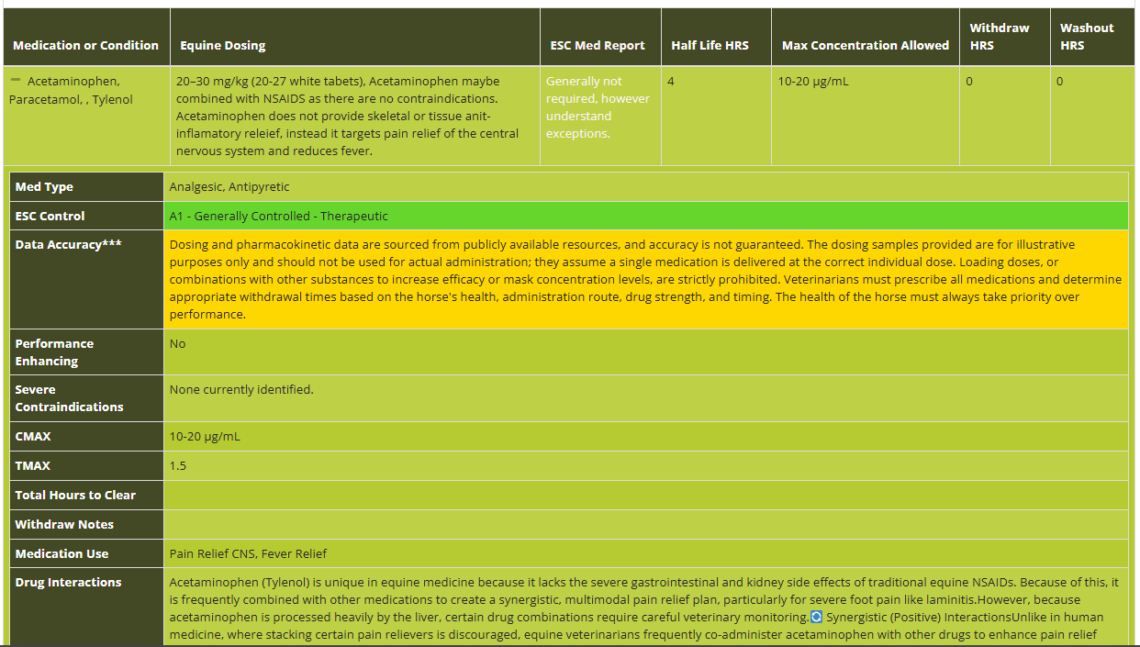
The cornerstone of this new digital resource is its advanced cross-reference search technology. Rather than relying on guesswork or generalized withdrawal windows, the ESC AI platform analyzes individual medication metrics, featuring explicit scores for:
- CMAX (Maximum observed plasma concentration)
- TMAX (Time to reach maximum plasma concentration)
- Half-Life (t 1/2 * 5) (The speed at which a drug is metabolized and cleared)
An Industry First: Comparing Impact, Risks, and Teamwork Between Drugs
In an industry-first milestone, the ESC platform brings together critical data points that have never been housed in a single digital location. The database allows users to simultaneously evaluate a medication’s performance-enhancing values, its contraindications, and its synergies.
Because these clinical terms directly impact horse safety and rule compliance, the database presents them in clear language for horsemen and support teams:
- Contraindications (What NOT to mix): Medical warnings indicating when a specific drug should never be used because it could harm the horse or conflict dangerously with another treatment.
- Synergies (Medications that work well together): Instances where two or more treatments interact positively, working as a team to enhance healing or pain relief more effectively than a single medication could do alone.
By delivering this data instantly through AI, the database eliminates common industry misunderstandings regarding optimal medication usage and timing.
Treatment Optimization and New Approved Therapies
In conjunction with the database launch, ESC has updated its active therapeutic guidelines to fully permit several new therapeutic treatments during active competition windows:
- Acetaminophen (Tylenol): Classified under Allowed Class A Therapeutics, Acetaminophen can now be fully utilized while competing. Highly effective at reducing fever and treating stubborn nerve pain, including laminitis and hoof related nerve issues. Acetaminophen acts as a selective COX-3 inhibitor that successfully blocks pain pathways while remaining exceptionally gentle on the equine gastrointestinal (GI) tract, eliminating the gastric ulcer risks often associated with traditional NSAID combinations.
- ESC permits combined therapeutic use of Tylenol and ONE (1) NSAID either Equioxx (no withdrawal) or Bute or Banamine (12 hr WD). Equioxx targets bones, joints and arthritis and Tylenol reduces fever and targets nerve discomfort. Combining these therapies expands the comfort of the horse without boosting performance or adversely affecting the digestive system. This combination must be veterinarian prescribed and a Medication Report submitted.
- Benozinate & Bromfenac: (Ophthalmic (Eye) Medications:) Two newly designated eye and corneal abrasion medications have been approved for complete utilization during events, ensuring that horses suffering from minor optical irritations or scratches can be safely and humanely treated without forcing withdrawal from a competition. Your veterinarian must diagnose and prescribe these topical agents – neither require a withdraw from competition. However if combining with Banamine a half dose regimen with 6 HR withdraw is permitted. Any other NSAID combinations for eye injuries are generally discouraged, however if medically necessary your veterinarian must get approval from the show vet and observe 48 hour washout period.
- Albuterol, Ventolin: – Short acting equine asthma treatment that relaxes airways. Unlike Clenbuterol Albuterol is very fast acting and is processed quickly by the horse’s system. Albuterol provides instant relief from bronchial spasms. Albuterol must be vet prescribed, and does not required withdraw from competition. It may not be combined with Dexamethasone or Clenbuterol.
- Guaifenesin, Mucinex: – Therapeutic centralized muscle relaxer used in inhalers to reduce airway mucus and during equine surgery as a muscle relaxant. Must be prescribed, and administered by a vet, who must also submit an ESC Medication report. A 48 hour withdraw is required.
Reclassification of Potentially Performance Enhancing Medications
ESC has evaluated the overall equine industry movement to prohibit use of Clenbuterol and Tri-Hist during competitions and has reclassified these medications as Class C-Strictly Controlled due to their illicit and performance enhancing values. If it becomes medically necessary to prescribe these medications, a medication report is required along with the following withdrawals.
- Clenbuterol – May only be used prior to competition as a single first phase dose of .5 mL/100lbs, followed by a 50 hour withdrawal. May not combine with Dexamethasone, Albuterol or Tri-hist without observing a 7 day withdrawal.
- Tri-Hist – Oral fed granules requires 24 hour WD after last feeding. May not combine with Clenbuterol, Albuterol or other antihistamines or decongestants without observeing a 72 hour withdrawal.
Preservation of Strict Veterinary Oversight
While the new AI database optimizes transparency for support teams, the ESC’s foundational welfare parameters remain completely intact. As enforced in previous competition seasons, Medication Reports continue to be strictly required for any therapeutic administration carrying a published withdrawal timeframe of 24 hours or greater or when ANY medications are combined.
Furthermore, the ESC mandates that a licensed veterinarian (within the state you are competing) must personally diagnose, prescribe, and oversee the administration of all controlled medications. Trainers and agents can easily cross-reference updated drug tiers and log required filings directly through the fully searchable platform today by visiting the ESC Controlled Medications Database
About Equine Sports Council (ESC)
Founded as a non-member sanctioning network, Equine Sports Council partners with individual horse shows to provide standardized rules, independent dispute resolution, and certified drug-testing services focused specifically on the unique needs of trotting breeds.