
ESC Controlled Medication Policy Update
PALMETTO, FLA — Equine Sports Council’s board appointed a three-person Controlled Medications Advisory Council (CMAC) in Q1-2026. This independent panel reviews laboratory reports from random drug testing at major events. ESC remains focused on a common-sense, efficacy approach that allows for therapeutic treatments while keeping the sport clean from performance-enhancing substances. A Quick Reference Guide of frequently prescribed medications is available to help exhibitors, trainers, and veterinarians easily navigate the Controlled Medication policy.
CONTROLLED MEDICATIONS | POCKET GUIDE
1. Understanding Lab Result Interpretation
ESC utilizes a three person Medical Advisory Council designed to ensure fair, unbiased evaluation of therapeutic concentration levels:
- Medical Advisory Council: A three-person equine medical panel reviews lab results that show levels exceeding standard guidelines.
- Independent Evaluation: Each member reviews the anonymized lab data separately to make an independent determination.
- Consensus Process: Decisions must be unanimous to move forward. If the initial votes differ, the team holds a discussion and votes a second time. If a consensus is still not reached, the case is dropped.
- Supportive Role: The medical team does not issue penalties or disciplinary sanctions; their only role is to clarify if a result is “Negative” or “Adverse.”
2. Available Therapeutic Options
Several supportive therapies can be utilized with specific guidelines for the safety and comfort of the horse:
- Supportive Care: Certain medications, such as Zyrtec, Albuterol Inhalers, Equioxx (Firocoxib) for arthritis, hormone therapy, navicular and Cushings medications may be used according to standard veterinary recommendations to maintain horse comfort.
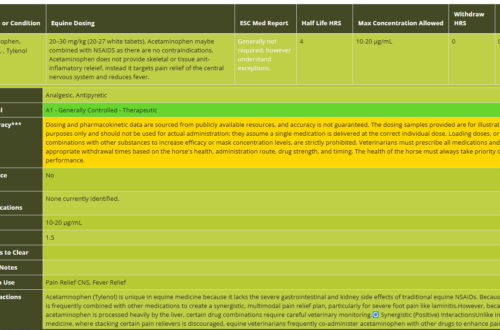
- Tylenol (Acetaminophen): May be paired with Equioxx (requires a Medication Report) or with a reduced dose of Bute (1/2 dose 6HR WD). Other combinations should be reviewed with a veterinarian.
- NSAID Considerations: When using medications like Bute or Banamine, it is recommended to work with a veterinarian regarding proper dosing, particularly when observing withdrawal periods. Only 1/2 dosages may be used with the 6 hour withdrawal time.
- Eye Care Drops: Standard ophthalmic drops like Benoxinate or Bromfenac may be used for acute minor abrasions. For chronic eye care, it is advised to submit an ophthalmologist treatment plan ahead of the show.
- Prioritizing Horse Health First: At all times, a horse’s health and well-being must take absolute priority over its performance in the show ring. Accordingly, the ESC does not permit horses to enter competition if they are exhibiting acute laminitis, visceral colic, or a fever of 102°F or higher. Additionally, horses experiencing myopia or eye abrasions that require more than 48 hours of continuous medical treatment must be reevaluated before returning to competition.
3. Guidelines for Combining Medications
ESC’s established concentration guidelines are designed to help ensure that a single medication is being used appropriately. Combining substances requires careful management.
- Medication Reports: Whenever a horse receives two or more therapeutic medications, a Medication Report is required. This administrative step helps track the horse’s care plan.
- Customizing Withdrawal Times: ESC encourages consulting with a treating veterinarian to determine the best medical care and withdrawal windows for the horse.
- NSAID Combinations: Avoid pairing two NSAIDs (such as using Bute and Banamine concurrently) as this leads to severe health risks within the GI tract and kidneys. Combining Bute or Banamine with Equioxx can result in performances exceeding natural abilities.
- Corticosteroid Considerations: Dexamethasone is widely used to support horses, and it is important to consider that combining it with NSAIDs or antihistamines can result in performance enhancing values. Additionally, Cox1 and Cox2 proteins are diminished causing GI and kidney issues.
4. Medication Classifications
To help exhibitors stay compliant, note the updated tracking for specific substances:
- Clenbuterol & Tri-Hist: These substances are categorized under Class C (Strictly Controlled – Performance Enhancing / Subject to Illicit Use) to allow for closer monitoring. A mandatory Medication Form must be submitted if either drug is administered.
- Withdrawal Guidelines: Clenbuterol requires a mandatory 50-hour withdrawal period. For Tri-Hist, the manufacturer currently recommends a 72-hour withdrawal time at sanctioned events.
- Compounding and Safety Caution: While ESC requires a minimum 24-hour withdrawal window for Tri-Hist, exhibitors are urged to use caution. Some formulations have caused banned stimulants to appear in plasma tests 15 to 25 hours after use. Tri-Hist can be re-ingested from stall contaminates. ESC highly recommends consulting your veterinarian to establish the safest withdrawal plan for your horse.
- Compounding Reminder: Caution is encouraged with compounded products, as variations in quality can occur.
Dedicated 24/7 Veterinary Support
To support you during major events, ESC staff and laboratory partners offer round-the-clock assistance to help veterinarians with guidance during the KSF World Championship and the Mid-America Mane Event horse shows.
- Direct Support Line: Veterinarians can reach out for guidance on treatment plans and compliance by calling ESC at 855-Equine1 (Option 1).
- Veterinarians must be licensed by the same state in which the horse show is held.
- Veterinarian Report Registration – May be requested by visiting our Controlled Medications page and choosing the Veterinarian Access tab.


You May Also Like
Equine Sports Council Launches Industry-First AI Controlled Medications Database to Optimize Therapeutic Timing and Compliance

ESC Implements Drug Policy Changes That Offer Improvements to the Management of Equine Tissue and Joint Inflammation