ESC Releases Annual Drug Testing Statistics
PALMETTO, FLA — Equine Sports Council (ESC) has published its annual drug testing statistics. This data provides full transparency into testing outcomes and ESC’s clinical-based efficacy policy which targets misuse of performance enhancing or banned substances.
When a horse show mandates randomized drug testing and collects the associated fee, a licensed ESC equine veterinarian attends the event to collect samples. These samples are secured and delivered directly to an ISO and RMTC accredited laboratory for confirmatory testing. 100% of the fees collected by the show are spent on drug testing for that event.
Lab Certification, Technology, and Interpretation
ESC partners exclusively with laboratories holding ISO/IEC 17025 certification. This designation confirms the highest technical competence for testing and calibration, serving as the explicit standard for equine/canine competition testing, livestock screening, and diagnostic toxicology. Additionally, chosen laboratories must specialize in Anti-Doping & Equine Integrity and hold accreditation from the Racing Medication & Testing Consortium (RMTC).
The testing process features advanced screening capabilities:
- Advanced Technology: Labs use liquid chromatography-mass spectrometry (LC/MS/MS) or gas chromatography-mass spectrometry (GC/MS) to isolate and identify exact molecular structures.
- Substance Screening: The lab randomly searches for more than 240 known substances.
- AI Analysis: ESC software uses AI-driven technology to compare detected substance concentrations against ESC allowed limits.
- Controlled Medications Council: If a adverse (over the allowable limit) result is detected, our Controlled Medication Review Council reviews the findings. The Council must reach a unanimous decision of either “Negative” or “Adverse” before any results proceed to the sanctioning stage.
- Digital Transparency: Every tested horse’s responsible agent receives electronic communication containing their certified lab results.
Judging the Show Horse vs. The Race or Olympic Athlete
Winning horses at Churchill Downs or the Olympic Games win solely based on speed or athletic execution. In contrast, show horses are evaluated on beauty, conformation and show ring presence. These traits account for 30-50% of the overall judging standards, and medication cannot manufacture these intrinsic traits.
Because medication cannot bridge a 30% to 50% performance gap, ESC categorizes all substances as either Therapeutic regimens or Strictly Controlled substances based on performance-enhancing potential and the overall safety and wellbeing of the horse.
ESC enforces rule violations through a tiered disciplinary system:
- Disqualifications: Only used when the severity or concentration of the medication is high enough to directly influence the class results.
- Internal Actions: Issues educational notices, formal warnings, or financial fines for minor infractions.
- Public Notifications: Keeps internal penalties private unless the severity of the violation warrants a public disclosure.
ESC Statistics Compared to HIWU
Equestrian regulation baselines rely on rigorous drug testing frameworks, which differ notably between global racing/Olympic formats and individual association standards.
Olympic and racing authorities typically test every horse, often conducting screenings both before and after an event. These organizations employ multiple testing methods, including efficacy-based tests to detect active substances currently affecting the horse, and retrospective tests, which can identify substances processed months or even years prior. [1, 2, 3, 4]
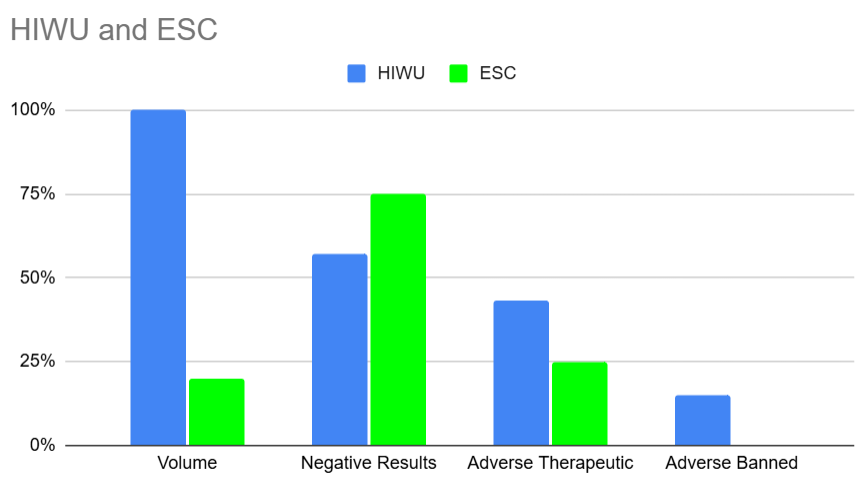
The data below compares the annual baseline statistics from the Horseracing Integrity & Welfare Unit (HIWU) against recent Equine Sports Council (ESC) data:
Regulatory Testing Statistics
| Metric | HIWU (2025 Annual Baseline) | ESC (2025 Championship Data) |
|---|---|---|
| Testing Volume | Over 73,000 horses tested across 364 days | 20% of classes tested |
| Negative Results | 57% of horses tested | 75% of horses tested |
| Adverse Therapeutic Overages | 43% therapeutic overage | 25% therapeutic overage |
| Banned Substances | 15% of adverse findings | 0% of adverse findings |