ESC Launches Medication Library
Equine Sports Council introduces a searchable Medication Library that brings medication facts, veterinary cautions, source links, and competition-rule comparisons into one place.
For trainers, owners, and veterinarians, a medication question rarely ends with a drug’s name. What is the active ingredient? Which other treatments need to be considered? What does a published concentration mean? And which organization’s rules apply at the next show?
The ESC Medication Library helps users find the relevant record and take a better-informed question to their veterinarian.
Explore the Medication Library →
Power searching: start with what you know
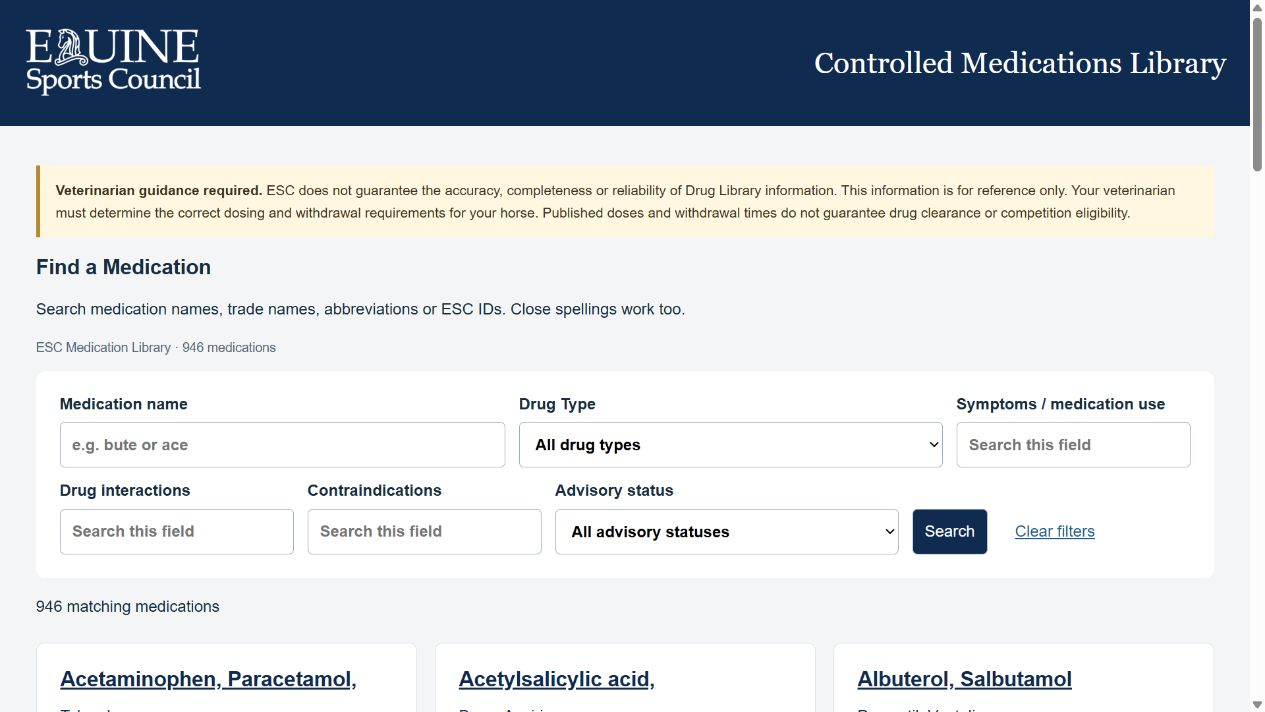
Search medication names, trade names, abbreviations, or ESC medication IDs. Additional fields let you narrow the search by drug type, symptoms or medication use, drug interactions, and contraindications. Close-spelling matches help when a name is unfamiliar.
- Explore Banamine / flunixin to see a medication record.
- Open firocoxib / Equioxx to explore another familiar trade-name example.
- Try a drug-type or interaction search, then review the complete record with your veterinarian.
A symptom search is a way to locate information—not a diagnosis or a recommendation to administer a drug.
Go straight to a medication
Know the medication name? For a published medication page, type its short address directly into your browser:
- EquineSportsCouncil.org/banamine opens Banamine / flunixin information.
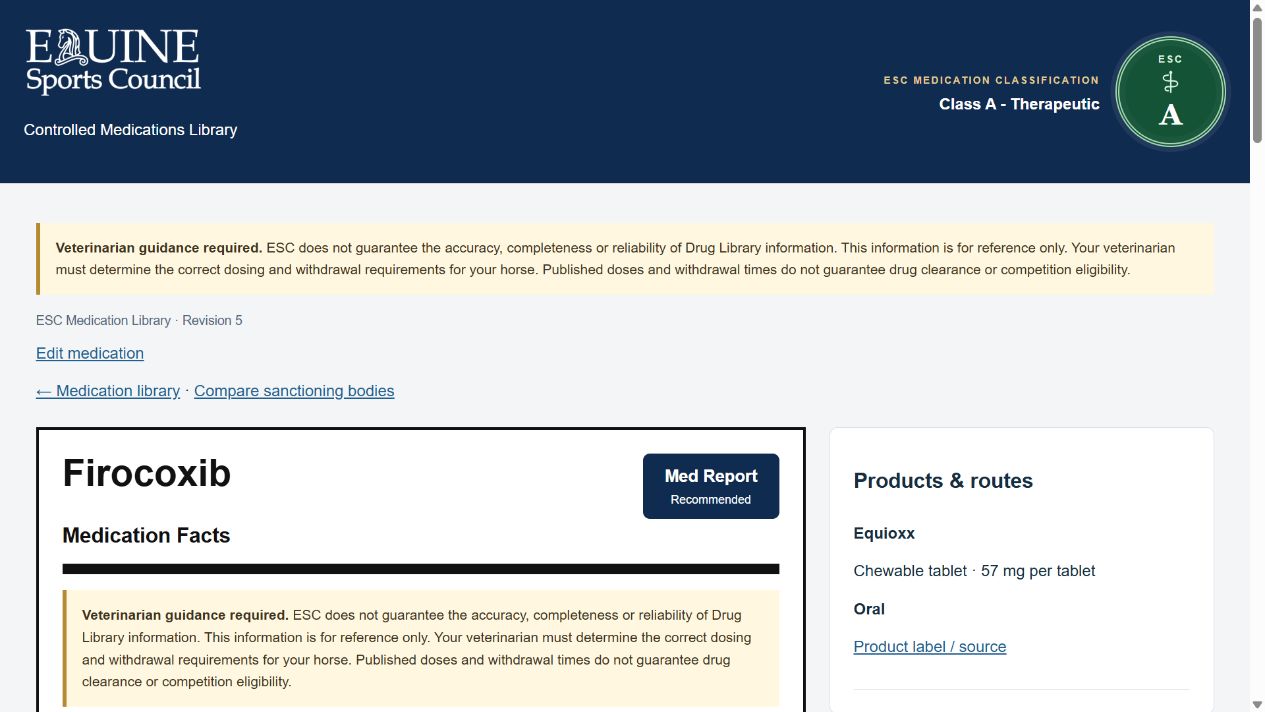
- EquineSportsCouncil.org/firocoxib opens firocoxib / Equioxx information.
Click either example to try it. You’ll go directly to that medication’s facts, interactions, contraindications, product-label links, and available rule comparisons. Page addresses use the library’s published name or slug; if a trade name or spelling does not open a page, search the library to find the correct record.
Search a condition, explore the medication cross-references
Condition and body-system searches now open a condition profile, with an overview, existing care background, veterinary assessment prompts, and links to medication records mentioned in the entry. Try Colic, Laminitis, or Asthma Breathing.
Not for diagnosis. These entries are illustrative cross-references to the ESC Medication Library only. Information is publicly sourced, may contain errors or omissions, and may be incomplete or outdated. Do not use it to diagnose your horse or choose or administer treatment. Consult your veterinarian for diagnosis and treatment.
Understand the numbers: Cmax, Tmax, and half-life
Medication records include pharmacokinetic information where available. These terms describe what happens to a drug in the body:
- Cmax: the maximum measured plasma concentration under the conditions described by the source. Think “how high the concentration peaks.”
- Tmax: the time after administration at which that peak concentration occurs. Think “when the concentration peaks.” It does not necessarily identify the time of greatest clinical effect.
- Plasma half-life: a measure of how quickly the drug concentration declines during the relevant elimination phase. It is not, by itself, a competition withdrawal instruction.
Route, formulation, regimen, and the individual horse matter. A published Cmax is not a permitted competition limit, and Tmax is not a clearance deadline. Read the pharmacokinetic research indexed in PubMed.
Look beyond a single medication
The interactions and contraindications sections bring attention to combinations and circumstances that deserve veterinary review. An interaction concerns how another substance can affect a medication’s action or risk; a contraindication concerns a circumstance in which use should be avoided or restricted.
Bring your veterinarian the full treatment list—including prescription medications, supplements, recent injections, and changes in treatment. Do not assume that two individually permitted medications are safe or permitted together.
Follow the links to the source
The library’s source and product-label links let users investigate the information behind a record. For drug labeling, visit DailyMed, provided by the National Library of Medicine, part of the National Institutes of Health (NIH). DailyMed includes labeling for human and animal drugs; check the species, formulation, and route for the product being reviewed.
For racing classification and model-rule references, visit the Association of Racing Commissioners International (ARCI). ARCI publishes model rules, therapeutic medication schedules, and classification and penalty guidelines. A model rule must be distinguished from the rules adopted by a particular jurisdiction.

ESC’s approach: clinical significance, trace amounts, and performance enhancement
ESC uses an efficacy-based approach that supports appropriate therapeutic care while guarding against performance enhancement. The presence of a substance and its clinical significance are different questions: some medications remain detectable after their useful effects have ended.
Trace detection: A laboratory may identify a small residual amount. Detection alone does not establish a clinically meaningful effect or a performance advantage. Equally, calling a result “trace” does not automatically make it compliant; the substance’s classification and applicable restrictions still matter.
Clinically meaningful concentrations: Interpretation asks whether the measured level is consistent with the medication’s expected action and ESC’s applicable guidance. An approved therapeutic effect within the rules is different from an adverse finding. “Clinical positive” should not be used as shorthand for every detectable result.
Performance enhancement: The drug’s action, concentration, and combinations matter. A legitimate therapeutic purpose does not make every dose, combination, or competition use acceptable. Restricted and banned substances remain subject to their specific rules.
Under ESC’s published review process, a three-person equine medical panel independently reviews anonymized laboratory results exceeding standard guidelines. The panel determines whether a finding is Negative or Adverse; it does not impose penalties. A unanimous determination is required to proceed.
The library helps explain this context. It cannot decide an individual laboratory finding or replace veterinary and ESC review.
Five rule frameworks, easier to compare
The library brings ESC guidance alongside four external frameworks. On supported medication pages, the comparison section shows published dose and route, plasma concentration guidance, withdrawal or timing provisions, and control or penalty classifications. Expand “Conditions & sources” to see qualifications and references.
- Equine Sports Council (ESC) — ESC controlled-medication guidance.
- American Quarter Horse Association (AQHA) — official rulebook.
- American Paint Horse Association (APHA) — official rulebook.
- United States Equestrian Federation (USEF) — Drugs & Medications Guidelines.
- Association of Racing Commissioners International (ARCI) — model rules and standards, a racing reference rather than a show-sanctioning body.
Try the live Banamine comparison →
These are five comparison frameworks, not a ranking of organizations. Coverage varies by medication. Check source dates and the governing rules for the actual event; a blank or unverified field does not mean permission, prohibition, or zero tolerance.
Keep reporting close at hand
Do not use these dosing illustrations to administer medication. Consult your veterinarian. This information is publicly sourced, may contain errors, and must be verified by your veterinarian before use.
Review the medication record’s reporting guidance and the full ESC policy with your veterinarian. When reporting is required, use the ESC Medication Report. The Frequently Prescribed Medications Quick Reference Guide is also available for your show-day paperwork.

Veterinarian guidance required. The library is a reference resource, not a prescription, a guarantee of drug clearance, or permission to compete. Your veterinarian must determine treatment and withdrawal requirements for the individual horse. Filing a report does not waive competition rules.